Tidal Wave: From Leyte Gulf to Tokyo Bay by Thomas McKelvey Cleaver
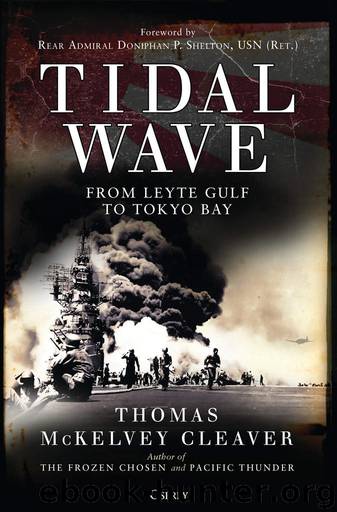
Author:Thomas McKelvey Cleaver [Cleaver, Thomas McKelvey]
Language: eng
Format: epub
Tags: 20th Century, History, Japan, Military, Naval, United States, World War II
ISBN: 9781472825483
Google: RAtODwAAQBAJ
Amazon: B07B3J7TSD
Publisher: Osprey Publishing
Published: 2018-05-22T03:00:00+00:00
CHAPTER NINE
THE FLEET THAT CAME TO STAY
By the spring of 1945, the Allied advance that had begun 32 months before at Guadalcanal was now aimed directly at the Japanese home islands. Okinawa, only 350 miles south of Kyushu, was seen by Allied planners as the logical end to the island-hopping campaign. It would be a springboard for the final assault on Japan itself, with airfields located only two hours away from the initial invasion target, Kyushu. The Japanese could read maps with equal facility and the strategic importance of Okinawa was not lost on the high command, which declared Okinawa “the focal point of the decisive battle for the defense of the Homeland” in March 1945.
The Okinawa campaign is better remembered as a slow struggle of attrition ashore that took on aspects of World War I trench warfare by the end, with over 12,500 Americans missing or dead and 82,000 wounded, with an additional 26,000 cases of “combat fatigue” serious enough for sufferers to be removed from their units. Enemy dead included 77,166 Japanese soldiers, and 42,000 to 150,000 civilians were killed, committed suicide or went missing, a significant proportion of the 300,000 estimated prewar local population.
At sea, however, Okinawa is the single bloodiest battle in US Navy history. By the time the island was declared secure after an 82-day-long struggle that lasted from April 1 until June 22, 1945, the Navy suffered 4,900 men killed or drowned and 4,800 wounded. Thirty-six ships were sunk and another 368 damaged: 122 destroyers, 19 aircraft carriers, 10 battleships, 12 cruisers and 69 auxiliary ships were hit as the Japanese flew 1,465 kamikaze aircraft in large-scale attacks from Kyushu, 185 individual sorties from Kyushu, and 250 individual sorties from Formosa between April 6 and June 22. Of the 145 ships sunk or damaged heavily enough to be out of action for 30 days or more, four were lost to mines, five to suicide small craft, three to coastal batteries, and 133 to Japanese air attacks. Additionally, 768 aircraft were lost in combat or operational accidents.
The losses and protracted length of the campaign led Admiral Nimitz to relieve the principal naval commanders early so they could rest and recuperate from the stress of command in conditions of the Okinawa battle. Thus, while Navy began the campaign as the Fifth Fleet under Admiral Spruance, it ended as the Third Fleet commanded by Admiral Halsey.
The result of the battle for Okinawa led to a complete change in US plans to defeat Japan and bring about surrender.
On March 23, 1945, Allied forces arrived off the Ryukyu Islands. Task Force 58, composed of 88 ships, including 11 fleet carriers, six light carriers, seven battleships and 18 cruisers, took position east of Okinawa in preparation for pre-invasion strikes. Radar picket destroyers were assigned in three-ship groups at four locations north of Okinawa to provide early warning of air raids coming from Kyushu.
Over the next week, American and British aircraft attacked airfields as far away as Formosa and Kyushu in an attempt to destroy the kamikaze aircraft before they could be put to use.
Download
This site does not store any files on its server. We only index and link to content provided by other sites. Please contact the content providers to delete copyright contents if any and email us, we'll remove relevant links or contents immediately.
| Africa | Americas |
| Arctic & Antarctica | Asia |
| Australia & Oceania | Europe |
| Middle East | Russia |
| United States | World |
| Ancient Civilizations | Military |
| Historical Study & Educational Resources |
The Radium Girls by Kate Moore(12035)
100 Deadly Skills by Clint Emerson(4931)
Rise and Kill First by Ronen Bergman(4797)
The Templars by Dan Jones(4691)
The Doomsday Machine by Daniel Ellsberg(4493)
The Rape of Nanking by Iris Chang(4220)
Killing England by Bill O'Reilly(4008)
Stalin by Stephen Kotkin(3973)
Hitler in Los Angeles by Steven J. Ross(3948)
12 Strong by Doug Stanton(3554)
Hitler's Monsters by Eric Kurlander(3347)
Blood and Sand by Alex Von Tunzelmann(3207)
The Code Book by Simon Singh(3197)
Darkest Hour by Anthony McCarten(3135)
The Art of War Visualized by Jessica Hagy(3013)
Hitler's Flying Saucers: A Guide to German Flying Discs of the Second World War by Stevens Henry(2758)
Babylon's Ark by Lawrence Anthony(2685)
The Second World Wars by Victor Davis Hanson(2529)
Tobruk by Peter Fitzsimons(2521)
